
Introduction
You can first think of a scenario: a new processing factory is doing pipeline installation, and the buyer ordered a batch of butterfly valves. What they like is that they are cheap, light, and space-saving. After a few months of installation, there is a harsh whistling sound in the pipeline. What’s more troublesome is that the valve begins to leak, and the whole production line can only be stopped for repair.
This is the problem. Butterfly valves are not the same; if the internal design is wrong, or the valve seat material does not match the conveyed fluid, the valve is easy to fail.
In this guide, let’s sit down and talk about the difference between the design, pressure level and material of butterfly valves. After reading it, readers can clearly know how to designate suitable valves for water treatment, chemical industry or HVAC projects, and the money will not be wasted.
What Is a Butterfly Valve?
The butterfly valve can be regarded as a quarter-rotating valve. There is a round valve plate inside the pipe, which is often called “butterfly plate”. After the handle is rotated 90 degrees, the valve plate will rotate, and the fluid will be blocked or released.
Saving space is an obvious advantage of this valve; gate valves and shut-off valves will take up more pipe length, butterfly valves are relatively thin, and the compact layout can also be easily installed. Large pipes are usually more economical.
However, the valve plate is in the middle of the water flow channel, and it is crucial to choose the right design; the cheap design is easy to make the water flow disordered, and the wear will also be accelerated, which will cause a lot of trouble for maintenance personnel to deal with.
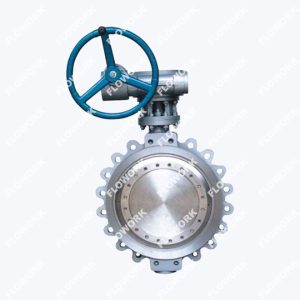
butterfly valves
Butterfly Valve Types by Design
How the valve is designed inside will determine how it is sealed, how much pressure it can withstand, and how long it can be used. There are three common designs in the market.
Concentric Butterfly Valve
This kind of design is the most basic. The valve stem passes directly from the center of the valve plate. The valve plate is completely in the middle of the pipe, and the valve seat is mostly made of soft rubber, such as EPDM or NBR.
The price of Concentric Butterfly Valve is very low, which is more suitable for low-pressure water systems and HVAC pipelines. Its disadvantage is that every time it is opened and closed, the rubber valve seat and valve plate will rub against each other. After a long time, the valve seat will be worn thin and may open Start to leak.
Double Offset Butterfly Valve
In order to reduce wear, the engineer made a double offset structure, and the valve stem deviates from the center of the valve plate and the center line of the pipe at the same time.
The effect of this is that when the valve is opened at the beginning, the valve plate leaves the valve seat almost immediately, and this “cam” action removes friction; Double Offset Butterfly Valve generally uses a soft valve seat, but the service life is longer than the concentric type. Quite a lot, the pressure that can be borne is also higher.
Triple Offset Butterfly Valve
The three eccentricity is to add an eccentricity on the basis of the double eccentricity to make the valve seat into an inclined conical shape, so that the metal and the metal are directly sealed; the valve plate only touches the valve seat when it is closed to the last millimeter.
Triple Offset Butterfly Valve is a kind of butterfly valve that can be carried. It has fire protection and safety performance, can withstand extreme temperatures, and can also achieve zero leakage when cutting. If the pipeline is high-pressure steam, hazardous chemicals or the working conditions are relatively harsh, choose three biases. The heart butterfly valve is more stable.
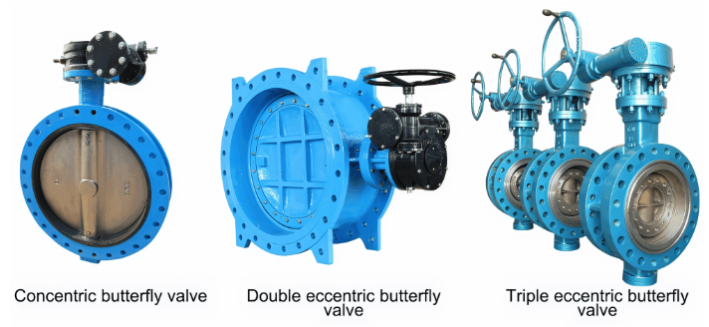
Concentric Butterfly Valve vs Double Offset Butterfly Valve vs Triple Offset Butterfly Valve
Butterfly Valve Types by Connection
How the valve is connected to the pipe will affect the cost and the subsequent maintenance, which is more important.
Wafer and Lug
Wafer valves are sandwiched between two pipe flanges and fixed by flange bolts; this kind of valve has the lowest price, but when there is still pressure in the pipeline, the downstream pipeline cannot be disassembled.
There are threaded metal inserts on the Lug valve body, which can be directly fixed on the flange with bolts; in this way, one end of the valve can be sealed and the downstream pipeline can be disassembled for maintenance.
Flanged and Butt Weld
Flanged valves come with its own flange, which is directly connected to the pipe by bolts. It is relatively heavy, but easy to disassemble.
Butt weld valves are permanently welded to pipes; such valves are used in situations where absolute zero leakage into the environment is required, such as high-pressure chemical pipelines.
Pressure Ratings and Size Range
When looking at the specification table, it is necessary to confirm whether the valve and the pipe can be mat, which needs to be clarified first.
PN and Class Ratings
There are two main types of common grade systems; PN, that is, nominal pressure, is more used in Europe and Asia. Common ones are PN10, PN16 and PN25; Class is ASME level, which is mainly used in North America, such as Class 150 and C Lass 300. As a buyer, make sure that the valve level matches the pipe flange level; if the level does not match, it is easy to pass the safety inspection.
Typical Size Range
The size range of butterfly valves is relatively wide, from DN50 for small pipelines, that is, 2 inches, to DN2000 for large water supply supervisors, that is, 80 inches; it should be remembered here that the larger the valve, the more difficult it is to turn, which means that it needs to be equipped with a gearbox or actuator. Only then can it produce enough torque and be safe to operate.
Materials of Construction
The material must be matched with the fluid flowing in the pipeline; once the material is selected wrongly, the valve may corrode within a few weeks.
Body and Disc Materials
- Cast Iron / Ductile Iron:that is, cast iron and ductile cast iron, is cheap and effective enough, suitable for cleaning water and HVAC systems.
- Carbon Steel (WCB):carbon steel, is suitable for general industrial use, oil and gas.
- Stainless Steel (CF8/CF8M): stainless steel, corrosive chemicals, food and beverage, and ship environments require this material.
Seat and Stem Materials
In terms of valve seat materials, EPDM is very suitable for water and steam, NBR is suitable for oil, PTFE is used for strong corrosive chemicals, and Metal seats are used for extreme high temperature and high pressure.
The valve stem material is usually stainless steel, that is, SS416 or SS316, which is commonly used to resist corrosion and provide sufficient strength.
Key Differences Between Butterfly Valve Designs
Let’s put the three main designs side-by-side. This table is what you want to look at when making your selection.
| Feature | Concentric | Double Offset | Triple Offset |
| Sealing Type | Soft Seat | Soft Seat | Metal-to-Metal |
| Pressure Limit | Low (PN10/16) | Medium (PN25/Class 150) | High (Class 300+) |
| Temperature Limit | Low (Up to 80°C) | Medium (Up to 200°C) | High (Up to 600°C+) |
| Leakage Rate | Standard | Tight | Zero Leakage (Fire-safe) |
| Cost | Low | Medium | High |
Actuation Options
The butterfly valve can be operated manually or automatically.
Lever and Gear Operated
The simple handle is suitable for small valves that do not need to be operated frequently. There is no problem with valves below 6 inches. After the valve becomes larger, it takes too much force to turn the handle by hand, so it is necessary to use gearbox, that is, handwheel, to reduce the required torque.
Pneumatic and Electric Actuators
If the valve is part of the automation system, it needs to be equipped with an actuator; Pneumatic actuators, that is, pneumatic actuators, fast action, low price, suitable for switch control or hazardous areas; Electric actuators are The electric actuator, with high accuracy, can also provide torque feedback, suitable for flow adjustment, or used in remote positions where compressed air cannot be taken.
Which Butterfly Valve Should You Choose?
When choosing a butterfly valve, you should first ask yourself two questions. One is what is the medium conveyed in the pipeline, and the other is what are the working conditions. After thinking about these two questions clearly, the valve type can be basically determined.
If the requirement is large flow, low cost, and only conventional isolation in the water system, then concentric, that is, concentric, can be an option; if the transportation is a chemical medium and needs to be closed more strictly, then consider double offset, that is, double bias. Heart; If it is under high-pressure conditions, requiring sufficient safety and zero leakage when cutting, then triple offset, that is, triple eccentricity, is the appropriate one.
The following quick selection comparison table can be used to help make decisions:
| Application | Recommended Design | Body Material | Seat Material |
| Water / HVAC | Concentric | Cast Iron / Ductile Iron | EPDM |
| Chemical Processing | Double Offset | Stainless Steel | PTFE |
| Marine / Seawater | Double Offset | Bronze / Duplex SS | NBR / EPDM |
| High-Pressure Steam | Triple Offset | Carbon Steel / SS | Metal |
What Makes FLOWORK a Trusted Butterfly Valve Manufacturer?
The buyer knows which kind of valve to buy, only half of the success, and the other half depends on whether the supplier is reliable and can avoid sending the leaking castings to the customer.
FLOWORK is a relatively important brand in the field of industrial fluid control, mainly providing high-quality butterfly valves for the oil and gas, chemical, ship and power industries. Unlike trading companies, FLOWORK controls the whole production process by itself, and its butterfly valves are designed and manufactured according to strict international standards. It involves the test requirements of API 609, ASME B16.34 and API 598.
For B2B buyers, FLOWORK is characterized by the fact that the source of materials can be found out; the product design covers a wide range, from standard concentric valves to high-performance triple offset valves, and each valve must go through before leaving the factory. Stricter stress testing; If the buyer is looking for a partner who understands engineering specifications and will not waste time because of inventory leakage, FLOWORK can be a reliable choice.
FAQs
What is the main difference between concentric and triple offset butterfly valves?
The concentric valve adopts a central soft rubber valve seat, which is more suitable for low-pressure general use; the triple offset valve adopts a tilted metal valve seat, which can achieve zero leakage isolation under high pressure and extreme temperature.
Can a butterfly valve be used for throttling?
Yes, but be careful; concentric valves are generally not very good at throttling, because the valve plate is directly in the middle of the channel, which is easy to cause turbulence, and the valve seat is also easy to wear; in contrast, double offset and triple of Fset valve is more suitable for throttling.
What is the maximum pressure rating of a butterfly valve?
The maximum pressure of the standard soft-seat concentric valve is about PN16 / Class 150; the pressure that the triple offset metal-seated valve can withstand is much higher, usually up to C Lass 600, or even Class 900.
Wafer or lug butterfly valve: which is better?
The price of wafer valves is lower, but they cannot be used at the end of the pipeline; the cost of lug valves is slightly higher, but the downstream pipelines can be disassembled for maintenance, which will perform better in factory operation.
Conclusion
Choosing a suitable butterfly valve, in the end, is to mat the design, material and connection method with the specific application; concentric valve is the main low-cost main force in the field of water and HVAC. Double offset and triple offset design, then It is a type that must be considered for higher pressure, chemicals and critical isolation occasions.
The pressure level should be verified, and the traceability of the material should also be checked. When purchasing, it is best to find a reliable manufacturer that has tested each valve before delivery. If you want to match the project with a suitable butterfly valve, just contact FLOWORK directly for a chat.
