 Skip to content

Introduction
In the face of B2B buyers or maintenance managers of fluid systems, they should know that the leakage of ball valve is actually not a small problem; this will not only bring safety hazards and environmental risks, but also cause the rapid loss of funds due to media waste and emergency shutdown. In this situation, some people may want to tighten the handle directly or order a new valve immediately, but there is no need to worry; the actual situation is that most leaks are often caused by several specific reasons, and many problems can be handled without removing the pipe. Next, let’s talk about why the valve leaks, where it leaks, and how to repair it.
How a Ball Valve Works
In the face of B2B buyers or maintenance managers of fluid systems, they should know that the leakage of ball valve is actually not a small problem; this will not only bring safety hazards and environmental risks, but also cause the rapid loss of funds due to media waste and emergency shutdown. In this situation, some people may want to tighten the handle directly or order a new valve immediately, but there is no need to worry; the actual situation is that most leaks are often caused by several specific reasons, and many problems can be handled without removing the pipe. Next, let’s talk about why the valve leaks, where it leaks, and how to repair it.
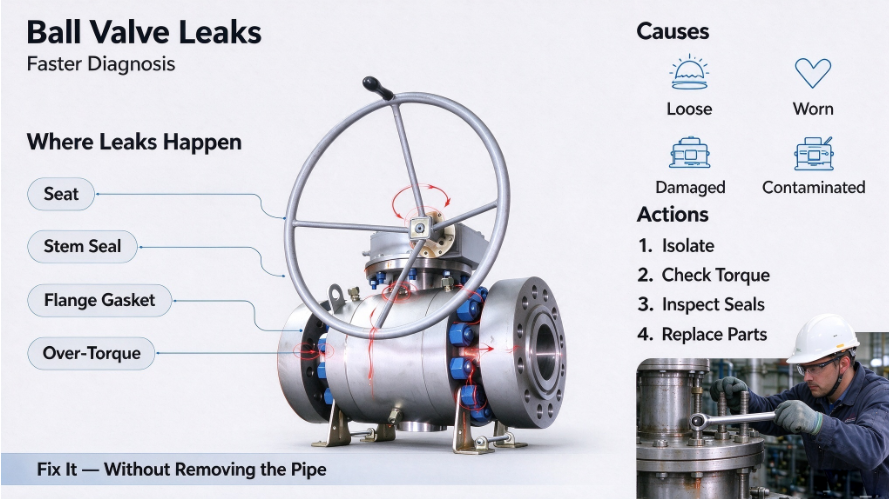
How a Ball Valve Works
Common Causes of Ball Valve Leaks
The failure of Ball Valve is usually caused by the following three main reasons:
Damaged Seats or Seals
The soft valve seat inside the valve tends to withstand greater wear; over time, corrosive chemicals, high temperature or just continuous use may cause the PTFE valve seat to wear, crack or lose its elasticity; once the valve seat is damaged, the fluid will bypass the sphere and leak.
Worn Stem Packing
Stem is a metal rod that connects the handle and the sphere. In order to prevent fluid from leaking from the top, it is wrapped in packing material, usually graphite or PTFE; if these packings become dry, shrink or wear out due to friction, The leakage phenomenon will appear in the position of the handle.
Debris and Contaminants
This is also a relatively common problem. If there is sand, pipe scale, weld slag or rust in the pipeline, these tiny particles may be stuck between the sphere and the valve seat; because it is blocked by debris, the sphere can no longer fit fully with the valve seat, thus causing leak.
Where Ball Valves Leak
If you want to solve the leakage problem, you must first figure out where the fluid is leaking from.
Stem Leaks
The symptom: The fluid drips down from the top, and the position is just below the handle.
The cause:Packing is worn or loose; this is the most common kind of leakage, and it is usually the easiest to repair.
Body Joint Leaks
The symptom: Fluid seeps out from the bolt junction of the two halves of the valve body, that is, the seam.
The cause: The body gasket fails under thermal circulation or chemical erosion; however, it should be noted that not all ball valves can be tightened directly at the body joint, and some are welded.
Seat Leaks
The symptom: The valve has been closed to the end, but the fluid is still flowing to the downstream pipe.
The cause: Debris is stuck on the seat, or the PTFE seat is scratched or broken.
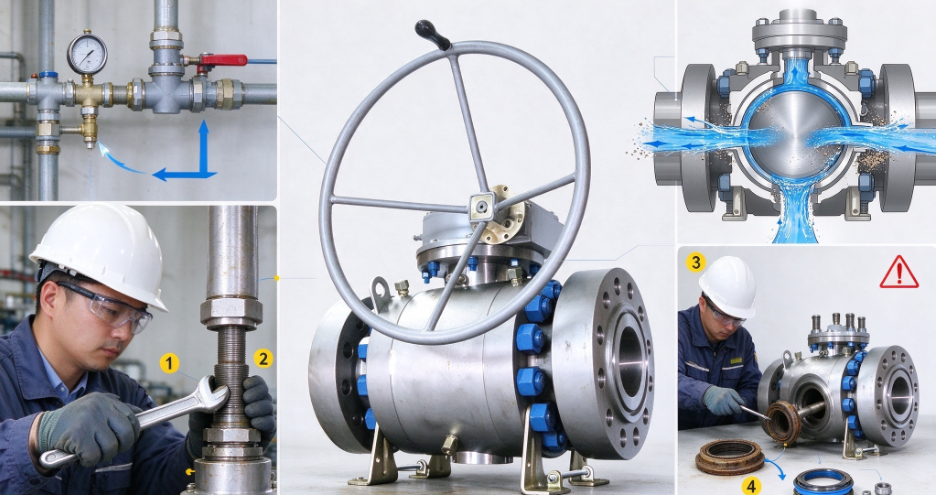
How to Fix a Leaking Ball Valve
Next, we will enter the specific processing steps. One thing must always be remembered, the pipeline must be depressurized first; never operate when the valve is still under pressure.
Tightening the Packing Nut
If the leak comes out of the stem position, don’t worry; look at the place where the stem enters the valve body, where you should see a packing nut, that is, a gland nut.
The way to repair it is to tighten it for a quarter turn with a wrench; then operate the valve to see if the leak has stopped.
Professional tips: Don’t screw the nut too much; if you use too much force, the handle may not turn, and the stem threads may be damaged.
Cleaning or Replacing Seals
- If the valve leaks from the seat, it may be simply because it is dirty inside.
- Flushing:While the fluid is still flowing, turn the valve back and forth several times; sometimes the ball’s own wiping effect can clean up the debris.
- Replacement:If the seats are worn out, you can buy a set of ball valve repair kit; you need to disassemble the valve, provided that it is bolted design, and then take out the old seats. Although this process is cumbersome, it is much cheaper than buying a new valve directly.
How to Fix a Leaking Ball Valve
When to Replace the Valve
Don’t force it to repair it; if the valve body has been cracked, or the sphere itself has deep scratches and erosions, or it is a cheap welded valve that cannot be disassembled at all, then replace the valve directly; whether it is labour cost or downtime loss, it is not worth repairing again.
The following quick check list can be reserved for the maintenance team:
| Leak Location | Cause | Action |
| Stem | Loose/worn packing | Tighten nut or replace packing |
| Seat | Debris or scratched seat | Flush line or replace seats |
| Body Joint | Failed gasket | Tighten bolts or replace valve |
| Body Casing | Corrosion or freeze damage | Replace valve immediately |
Prevention and Maintenance Tips
If you want the ball valve to leak from the beginning, there are three things you need to do well.
- Exercise the valve:Don’t let the valve stay in the same position for several years in a row; you can turn it on and off every few months, which can avoid the adhesion of seats and keep the packing Live in flexibility.
- Filter your media:If the transport is slurry or dirty water, a Y-strainer can be installed upstream so that the debris can be intercepted before entering the valve.
- Match the material:Strongly corrosive chemicals should not be handled with brass valve, and high-pressure steam should not be handled with standard PTFE seats; valve trim needs to be treated with fluid. The media is matched.
What Makes FLOWORK a Trusted Ball Valve Manufacturer?
A better way to deal with valve leakage is to buy a durable valve from the beginning.
FLOWORK has many years of experience in the field of fluid control, mainly providing high-quality ball valves for the oil and gas, water and petrochemical industries. Compared with those trading companies whose source of parts is often unclear, FLOWORK controls the whole production process by itself, so it casts The quality of the parts is relatively strict, and the precision of machining is relatively high.
When designing and testing these ball valves, they refer to strict international standards such as API 6D and ASME B16.34. Each valve will undergo a relatively strict shell and seat pressure test before leaving the factory; if the buyer uses that kind of half FLOWORK’s engineering team can assist in the selection of suitable full-port or reduced-port valves, and can also match the corresponding valve body materials and seat materials for specific applications.
FAQs
Why is my ball valve leaking from the stem?
The ball valve leaks, and sometimes it comes out from the position of the stem. This is mostly because the stem packing has been used for a long time, and it has dried up or loosened. In this case, you can try to tighten the packing gland nut for a quarter of a turn. If it still doesn’t work after this operation, then the packing rings may need to be replaced.
Can a ball valve leak when it is half open?
If the valve is only opened halfway, this situation will indeed cause leakage, and the damage will be relatively great. If the ball valve is used for throttling, that is, if the valve is partially open, the fluid with high flow rate will rush out of the gap, resulting in cavitation. This phenomenon will accelerate the erosion of seats, and if it is serious, leakage will follow. Therefore, when the ball valve is used, it should be kept in a fully open or completely closed state.
How do I stop a ball valve from leaking?
First of all, you need to turn off the pipeline and release the pressure cleanly. If the leak is on the stem side, just tighten the nut. If the seat leaks, you can try to flush the pipeline. If the seals have been broken, you have to use a repair kit to deal with it, or replace a new valve directly.
When should I replace a leaking ball valve?
If you find that the body has cracked, or there are serious scratches on the ball, or the cost of buying a repair kit and the labour cost have exceeded 60% of the price of the new valve, it is better to buy a new one directly.
Conclusion
When the ball valve leaks, it does make people feel a little headache, but this situation is generally not completely undealable; in about 90% of cases, the problem is often just that the packing nut is loose, or the seat is stuck. It’s just debris. As long as you clarify the working method of the valve and prepare a little spare parts at ordinary times, the maintenance team can fix most leakage problems within an hour.
Of course, if you are already annoyed by the repeated repair of valves, you may need to consider a better supplier; if the next project just needs to purchase ball valve, FLOWORK can provide valves that meet the API standard, and there are also stricter Supported by the test process and global project experience. If necessary, you can directly contact FLOWORK to communicate your specific needs, so as to obtain the kind of valve that is more durable and can be managed for a long time.

