
Introduction
If B2B buyers are purchasing valves for water supply lines or industrial facilities, they may find that they are the same ball valves, but they are very different from each other; the internal design of these valves is more obvious, and the design is precisely the most critical point. Many buyers will think that the ball valve is similar to the faucet. As long as the handle is turned halfway, the pressure can be reduced; but if it is really operated in this way, the system may have serious bubble burst damage, that is, cavification, the valve may be destroyed within a few months, and the pipe will make a harsh whistle. In a high-pressure water system, whether the pressure control is in place is not an unnecessary addition, but a must. If the flow control is improper, the downstream pressure will become unstable, and sensitive equipment may fail.
Let’s talk about the actual situation of ball valve pressure drop,readers can understand how it actually works, why it is not suitable for use as a decompression device, and how to choose a suitable solution for the business.
What Determines Water Pressure in a Pipeline
Before putting the responsibility on the valve, the purchaser needs to figure out where the water pressure actually comes from; the water pressure is not a random number on the pressure gauge, but actually the result of the common balance of multiple physical forces.
The water pressure is mainly determined by several aspects. First, the static pressure head, that is, the height of the water source or water tower; second, the dynamic pressure head generated during the operation of the pump; third, the loss caused by internal friction of the pipe wall; and fourth, the impact of changes in the position in the system; if the municipal supervisor enters the water at a pressure of 120 PSI , and the water utensils in the facility can only withstand 50 PSI, and the 70 PSI that comes out will remain in the pipe, which may cause damage at any time.
The key here is that the valve can limit the flow rate, but it cannot change the static pressure acting on the pipe wall out of thin air.When the flow stops, the pressure will return to the maximum static pressure level
How a Ball Valve Works in a Water System
To figure out why the ball valve cannot be used as a pressure regulator, you must first look at its internal structure.
Full Port vs Reduced Port Design
There is a metal ball with a hole inside the ball valve.
- Full Port:the pore diameter is exactly the same as that of the pipe; when the valve is opened, the water flow can hardly feel the existence of the valve, and the pressure drop is close to zero.
- Reduced Port:the aperture is one size smaller than the pipe; this will form a slight bottleneck, but the purpose of this design is still on/off control, that is, switch control, not to regulate the flow rate.
Quarter-Turn Mechanism and Flow Control
The main problem is here. The ball valve belongs to the quarter-turn valve; the handle only needs to rotate 90 degrees, and the valve can change from 0% opening to 100% opening. Most of the flow is concentrated in the first 20% to 30% of the handle rotation, and the rest Turning almost doesn’t work. Therefore, it is appropriate for the ball valve to quickly cut off the water flow, but the effect is very poor if the flow is fine and smooth.
Can a Ball Valve Reduce Water Pressure?
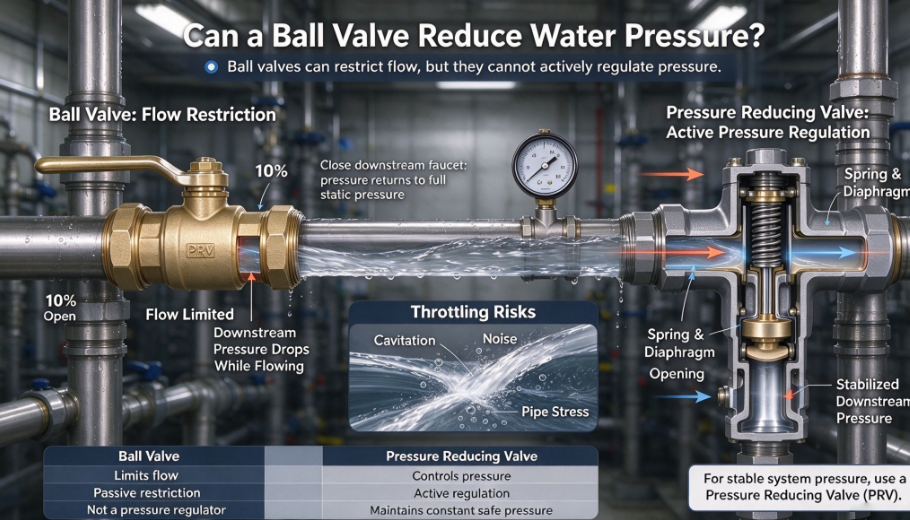
Technically speaking, the ball valve can reduce the water pressure. As long as it is turned on by 10%, the flow rate will be limited.However, it depends on what actually happens in the system after this operation.
Flow Restriction vs Pressure Regulation
Throttle the ball valve actually creates a resistance in the pipeline; when the water flows, the pressure downstream of the valve will drop, but once a downstream faucet is closed and the flow stops, the pressure will immediately return to full static pre Ssure. Ball valve cannot actively regulate the pressure. It can only limit the flow rate, so it is not a water pressure regulator.
Cavitation and Noise Risks When Throttling
Throttle the ball valve actually creates a resistance in the pipeline; when the water flows, the pressure downstream of the valve will drop, but once a downstream faucet is closed and the flow stops, the pressure will immediately return to full static pre Ssure. Ball valve cannot actively regulate the pressure. It can only limit the flow rate, so it is not a water pressure regulator.
Impact on Downstream System Pressure
Throttle the ball valve actually creates a resistance in the pipeline; when the water flows, the pressure downstream of the valve will drop, but once a downstream faucet is closed and the flow stops, the pressure will immediately return to full static pre Ssure. Ball valve cannot actively regulate the pressure. It can only limit the flow rate, so it is not a water pressure regulator.
Can a Ball Valve Reduce Water Pressure
Ball Valve vs Pressure Reducing Valve: Key Differences
If the pressure needs to be controlled on the site, it is not a ball valve, but a Pressure Reducing Valve, which is a pressure reducing valve, or PRV for short. PRV automatically adjusts the internal opening by springs and diaphragms. When the inlet pressure rises, it is turned down a little, and when the inlet pressure falls, it opens a little more. No matter how the flow rate changes, it can stabilize the downstream pressure at a constant and safe level.
| Feature | Ball Valve | Pressure Reducing Valve (PRV) |
| Primary Function | On/Off Isolation | Automatic Pressure Regulation |
| Throttling Ability | Very Poor (Causes Cavitation) | Excellent (Built for it) |
| Downstream Pressure | Fluctuates with flow | Constant, stable pressure |
| Risk of Damage | High, if used for throttling | Low, designed for continuous adjustment |
When to Use a Ball Valve for Flow Control
If on/off isolation is required, that is, when the switch is isolated, use ball valve; emergency cut-off, bypass lines, or completely stop flow for maintenance, ball valve is more suitable for these occasions, use It should be fully opened or closed. It’s as simple as that.
When to Choose a Pressure Reducing Valve
When it is necessary to reduce the pressure of the main line to a level that the facility can use, choose PRV; it can not only protect the equipment, but also prevent the operator from high-pressure impact.
Best Practices for Managing Water Pressure
When choosing a valve to manage water pressure for enterprises, there are several aspects that need to be thought about first, so that it is not easy to make a mistake later.
Correct Valve Sizing and Selection
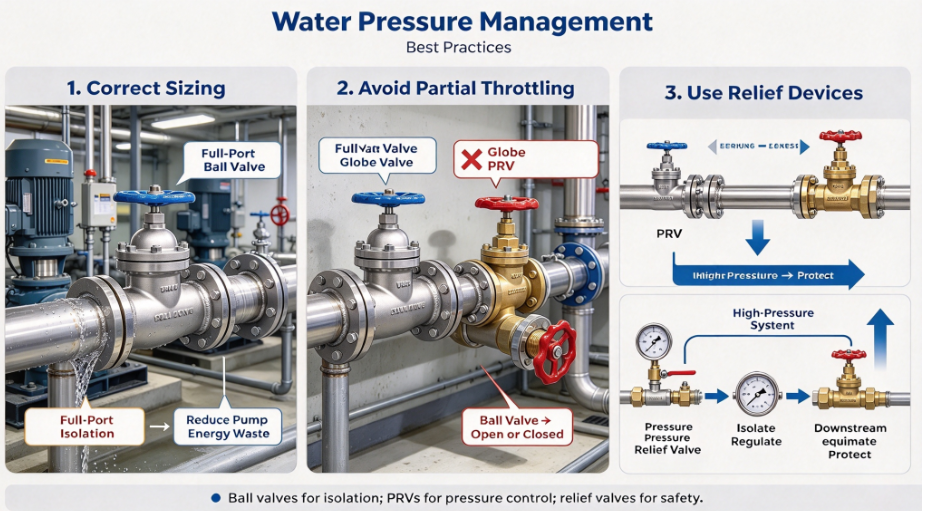
Don’t take a ready-made ball valve and force it to adjust the pressure; the pipeline pressure and pipe size should be checked first. Full-port ball valve can be used for isolation, so that the flow rate will not be unexpectedly limited, and the energy consumption of the pump will not be It’s a waste.
Avoiding Partial Throttling of Ball Valves
Ball valve should not be used as a faucet, which should be avoided; if the site needs to control the flow or reduce the pressure, you can use globe valve, which is originally designed for throttling, and you can also use a special PRV. ; the ball valve is either fully open or fully closed.
Combining Ball Valves with Pressure Relief Devices
If the system belongs to a high-pressure system, the configuration can be arranged in the following order. First, use the ball valve for isolation, then use the PRV to regulate the pressure, and finally install a pressure relief valve downstream, that is, a safety valve, to prevent PRV. There is a problem after the failure.
Best Practices for Managing Water Pressure
What Makes FLOWORK a Trusted Ball Valve Manufacturer?
The buyer knows which kind of valve to buy, which is only half successful, and the other half depends on whether the supplier is reliable and can avoid sending leaking castings to the customer.
FLOWORK has a relatively deep accumulation in industrial fluid control manufacturing. It is the main supplier of high-quality ball valve and has a lot of experience in water treatment, oil and gas and shipping industries. In some trading companies, the source of parts is not easy to find out, while FLOWORK The whole production process has been controlled, so the quality is relatively stable, and the delivery date is not easy for buyers to wait all the time.
Their ball valve is designed and tested according to strict international standards, including API 6D and ASME B16.34; whether it is the kind of full-port ball valve required by high-flow water supply supervisors, or for processing plants Heavy-duty reduced-port valve, FLOWORK has the corresponding manufacturing capacity to deliver.
The key point is in the test link. Each valve will be tested for pressure and leakage before leaving the factory, so that the high cost of on-site return can be reduced. If the buyer values the traceability of the material and the relatively reliable delivery cycle, FLOWORK can be tested as a reliable partner.
FAQs
Can a ball valve be used as a pressure reducer?
It can’t be used in this way. This practice is neither effective nor safe. If the ball valve is partially closed, the flow rate will indeed be reduced, and there will also be a temporary pressure drop, but the pressure is not really adjusted. Cavitation, noise and valve strict Heavy wear and tear may follow.
Does partially closing a ball valve reduce water pressure?
When the water flows through, the flow rate will decrease and pressure drop will also occur; however, this will cause serious turbulent, and the valve may also be damaged, so it is not recommended to use ball valve for pressure control.
What happens if you throttle a ball valve?
When the water flow passes through the narrow opening, the speed will accelerate, thus causing cavitation; after the formation of tiny vapor bubbles, they will collapse violently, thus eroding the valve and producing greater noise and vibration.
What is the best valve to reduce water pressure?
Pressure Reducing Valve, or PRV, is the device suitable for this work; no matter how the flow rate changes, it can actively adjust it to keep the downstream pressure stable.
Conclusion
The water pressure management method ultimately depends on the application scenario. Ball valves can quickly cut off the flow, but the pressure cannot be adjusted, and usually only undertake switch control; what is really used to reduce pressure is usually Pressure Reducing Valves; if you take b All valves do throttling, then cavitation, noise and equipment damage may follow.
For B2B buyers, choosing the right valve will ensure the reliability, efficiency and safety required for the key water system; FLOWORK’s ball valve product line is relatively complete, and the full-port and reduced-port series are designed Referring to the stricter test standards, all products will be tested for pressure before leaving the factory, for commercial and industrial occasions with high requirements; when you need to choose a suitable ball valve for the project, you can contact FLOWORK directly to help confirm.
