
Introduction
If B2B buyers are purchasing valves for industrial fluid systems, water treatment plants or oil and gas projects, they may find that ball valves can be seen everywhere; such valves are not expensive, compact, and convenient to use, but if the internal design or materials are wrong, they will finally take The valve may leak under high pressure, get stuck when rotating, or corrode after a few months of installation. Next, let’s talk about the definition of ball valve, the working method, and how to choose the right valve for the business without wasting money.
What is a Ball Valve?
Simply put, ball valve is a quarter-turning valve, which relies on a hollow, perforated and rotating sphere to control the flow of liquid or gas.
There is a metal ball with a hole inside the valve body. When the hole is aligned with the pipe, the fluid can pass through; after turning the handle, the ball rotates and the flow is blocked.
The reason why buyers prefer this kind of valve is that it is quite durable, the seal is relatively tight, can reach the level of bubble-tight sealing, and it takes up little space; it is different from the gate valve that needs dozens of turns to open, ball valve operation is completed in an instant.
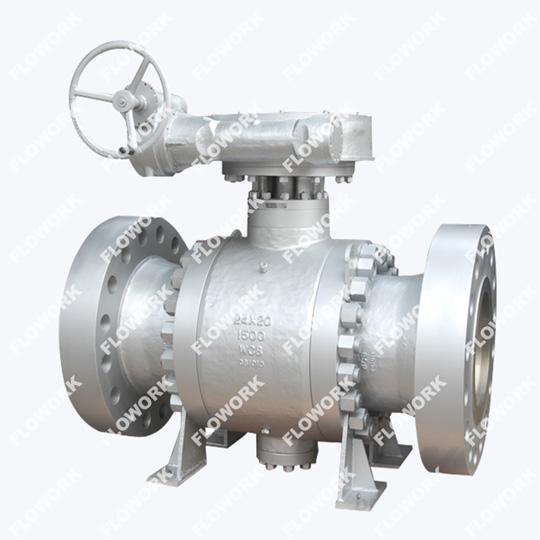
ball valves
How Does a Ball Valve Work?
The working principle of Ball valve is actually not complicated, but there are still a few technical details that need to be clarified before purchasing.
Quarter-Turn Mechanism
The operation method of the ball valve is to turn the handle 90 degrees, which is as simple as that; the valve stem connects the handle to the ball, so with just a quarter-turn, the valve can change from fully open to completely closed.
Open, Closed, and Throttling Positions
- Open:The hole on the ball is aligned with the pipe, and there is almost no resistance when the fluid flows over.
- Closed:The handle rotates 90 degrees, and the solid side of the sphere blocks the pipe.
- Throttling:This is where buyers are more prone to problems; if the valve is only half open to control the flow, the fluid speed will rise sharply in a very small gap, which will cause turbulence, noise, and may actually erode the sphere and seal, that is, cavitation; Standard ball valves should not be used for throttling. They are only suitable for on/off isolation.
Sealing and Flow Control
The seal is usually made of PTFE, that is, Teflon, or similar polymers; when the sphere is turned to the closed position, these soft valve seats will be pressed to form a tighter seal. If the medium temperature is high or abrasive, metal-seated ball valve will be used instead.
Types of Ball Valves
When buyers look through the product catalogue, they will see a lot of options; the following quick check table can be used to make a general distinction first.
Floating Ball vs Trunnion Mounted
- The sphere of theFloating Ball is not fixed. The fluid pressure will push the ball downstream to the valve seat, and the seal is formed in this way. This design is low in price, light in weight, and more suitable for small size occasions. It is usually used below 8 inches.
- The ball of Trunnion Mounted is fixed by the top and bottom shafts, that is, trunnion, and the valve seat is close to the ball; this structure requires less operating torque, which is basically a must-chosen type in large-size and high-pressure applications.
Full Port vs Reduced Port
- The bore of full port, that is, the aperture, is the same as the size of the pipe, with the largest flow and the pressure drop close to zero; it can also let the pipe cleaning tool “pig” pass through the pipeline.
- The bore of reduced portis smaller than that of the pipeline, which can save some cost and space, but it will produce pressure drop and turbulence; this design is only suitable for occasions where the flow restriction has little impact.
Manual vs Actuated Valves
- Manualis a simple handle or handwheel, which is suitable for valves that are rarely operated.
- Actuatedis to connect the pneumatic actuator or electric motors to the valve stem; if the valve is part of the automation system or installed in a remote position, it needs to be equipped with actuation.
Key Applications and Advantages of Ball Valves
Why did ball valve become the most sold valve type in the world?
Low Flow Resistance and Fast Shut-off
After the sphere is fully opened, the fluid can hardly feel the existence of the valve, so that the energy consumption of the pump is not easily wasted; in addition, the handle can be turned 90 degrees to achieve emergency cut-off, which is relatively fast.
Industrial, Commercial, and Residential Uses
The use of ball valve can be seen in many places:
- Industrial, that is, industrial occasions, such as oil and gas pipelines, chemical processing and power plants.
- Commercial, that is, commercial occasions, such as HVAC systems, water treatment and fire pipelines.
- Residential, that is, residential occasions, such as home water supply supervisor, gas pipeline and plumbing.
Material Selection for Different Media
- Don’t just buy a general-purpose valve and use it. The material should be matched according to the fluid:
- Brass/Bronze, that is, brass and bronze, is very suitable for cleaning water and residential plumbing.
- Carbon Steel (WCB),that is, carbon steel, is suitable for oil, natural gas and high-pressure steam.
- Stainless Steel (CF8/CF8M),that is, stainless steel, this material is needed for corrosive chemicals, seawater and food processing.
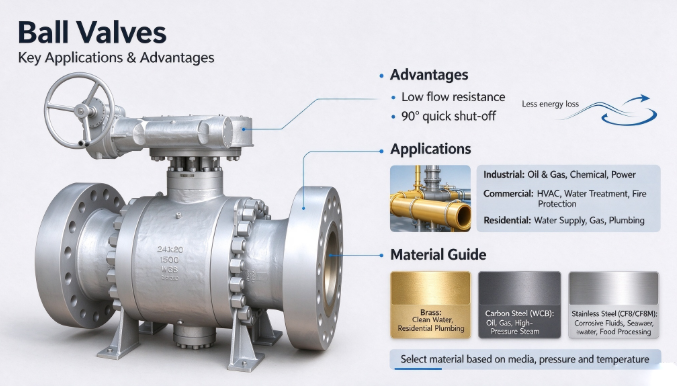
Key Applications and Advantages of Ball Valves
Common Considerations and Maintenance
In order to avoid trouble in later use, the following aspects need to be remembered first.
Pressure and Temperature Ratings
The PN or Class level should be checked all the time, and the valve must mat the pressure limit of the pipeline; in addition, remember that the maximum useable temperature of the standard PTFE valve seat is about 200°C, which is about 392°F. If the temperature is higher, it needs to be changed to metal seats.
Installation Best Practices
When installing the valve, the position of the handle should be convenient for subsequent maintenance and operation; the pipe weight should be supported on both sides of the valve to avoid additional stress on the valve body; the pipeline should also be flushed before installation to prevent debris from scratching the ball and the valve seat.
Troubleshooting Leaks and Wear
There are two common reasons for the leakage of the ball valve. One is that the debris is stuck between the ball and the valve seat, and the other is that the PTFE valve seat is worn out; sometimes as long as the valve is turned halfway and flushed, the debris can be taken away; if the valve seat is permanently worn out, usually only the valve seat is replaced. Yes, there is no need to replace the whole valve.
What Makes FLOWORK a Trusted Ball Valve Manufacturer?
If the buyer knows what to buy, it can only be half of the success. The other half depends on whether the supplier is reliable and can avoid sending the missing castings to the customer.
FLOWORK has been in the field of fluid control for many years. It is the main supplier of high-quality ball valves, and has a deep accumulation in the oil and gas, petrochemical and ship industries. In some trading companies, the source of parts is not easy to find out, while FLOWORK controls the whole life by itself. The production process, so the quality is relatively stable, and the delivery date is not easy for buyers to wait.
Their valves are not only decent in appearance, but also designed and tested in accordance with strict international standards such as API 6D, API 598, API 607 and API 6FA; whether it is a floating ball valve for small water supply lines, Or a heavy-duty trunnion-mounted ball valve with a size from 2″ to 56″ and a pressure level of 2500LB, FLOWORK has the corresponding manufacturing capacity to deliver; full-bore or reduce D-bore options, automatic pressure relief, fire-safe design, anti-static devices and blow-out proof stems can also be selected as needed.
What makes buyers feel at ease is in the testing link. Each valve will undergo a stricter pressure test before leaving the factory, so the number of on-site returns can be reduced. If the buyer encounters difficulties in matching standards, materials and specific media, temperature and pressure, the engineering team of FLOWORK can provide guidance.
FAQs
What is the primary purpose of a ball valve?
Its main purpose is on/off isolation, that is, switch isolation; the design is to make the flow of liquid or gas quickly and completely open or completely stop through quarter-turn.
Can a ball valve be used to regulate flow?
It is not very suitable; although the valve can be partially closed, it is not good to do so. The standard ball valve is not designed for throttling, which will cause turbulence, cavitation, and accelerate the wear of the seal; to adjust the flow rate, you should use g Lobe valve or control valve.
What is the difference between a full port and a reduced port ball valve?
The bore of the full port valve is the same as the pipe size, the pressure drop is close to zero, and the pipe cleaning is also allowed, that is, pigging; the bore of the reduced port valve is smaller, which can save some costs, but It will bring flow restriction.
How do I choose the right ball valve for my application?
Materials should be matched according to the fluid. For example, stainless steel can be used for chemical occasions; floating ball can be selected for small or medium size, and trunnion-mounted can be selected for large or high-pressure pipelines; pressure level and temperature The level should also be verified to ensure that it is in line with the system.
Conclusion
Choosing a suitable ball valve, in the end, is to make the design, material and connection method with the specific application; in the occasions of water, chemicals and gas pipelines, ball valve belongs to the low-cost and more widely used category. When using it, just remember one thing and let it bear On/off isolation, that is, switch isolation, don’t use it for throttling, that is, throttling adjustment.
The pressure level should be verified, and whether the source of the material can be found out should also be checked. When purchasing, it is better to find a reliable manufacturer that has tested each valve before delivery.
If the buyer is purchasing ball valve for the next project, FLOWORK can provide both API 6D pipeline valves and heavy process valves, backed by strict tests and global project experience; when the project needs to confirm the standards and materials, it can be directly Contact FLOWORK and explain the application requirements clearly.
