 Skip to content

Introduction
For B2B buyers who buy ball valves for oil and gas projects, they often encounter an unusual situation. The two valves look similar and weigh the same, but the price is twice as different.
The root of this difference is that one of them is labelled with API 6D, and the other is labelled with API 608. Many buyers sincerely think that these two standards can be used casually. In the end, the result is nothing more than spending more money on buying things, or the valve can’t pass the on-site test; in fact, these two standards are not interchangeable at all.
If the standard is not chosen right, the buyer may spend a lot of money to buy back a bunch of useless specifications, or after installing the valve, it will start to leak as soon as the system pressure fluctuates. Therefore, the following content will not talk about those sales routines in a roundabout way, but directly explain the impact of these two standards on the actual project.
What Are API 6D and API 608?
The American Petroleum Institute (API) does not formulate these rules casually, mainly because the risks in different usage environments are not the same.
API 6D can be regarded as a very strict standard. It is basically designed for long-distance pipelines, centralised transmission networks, and remote transmission and distribution stations. This standard is aimed at those deserted areas, where valves may be buried underground for 20 years, and no one will usually go there. View, so it needs to be able to withstand high pressure, harsh fluids, and the worst working conditions.
In contrast, API 608 can be regarded as a conventional standard. It is mainly used in metal ball valves inside process facilities, such as refineries, chemical plants, and processing plants. This standard is used in factory workshops, where there are control rooms, pressure relief valves, and maintenance personnel in daily inspections. It mainly If it is formulated for controllable risks and cost-effectiveness.
API 6D: Pipeline Valve Standard
Scope and Applications
API 6D valves are usually regarded as the last line of Defence on the main road; if one of the valves breaks, the consequences will not only be a pool of water in the factory, but also cause environmental disasters and face a huge fine issued by the environmental protection department. Because such valves are generally installed in unmanned stations or buried in the ground, they must be almost faultless.
Design and Testing Requirements
The requirements of API 6D are very clear, and full-bore design is strictly required. Why is there such a requirement? Because the pipeline operator must put a “pig” detector through the pipeline to scrape off the wax and check cracks; if the bore of the valve is relatively small, the pig will be stuck, so that the whole pipeline will have to stop.
In addition, if it is a trunnion-mounted valve, double block and bleed, that is, the double block discharge function, and the automatic pressure relief function of the valve cavity are mandatory; the maintenance personnel must be able to safely press the pressure before starting the maintenance.
What really causes the price to rise is the testing link; each valve must pass high-pressure and low-pressure seat tests at the same time, among which the low-pressure gas test is very important because it can find micro-leaks that cannot be detected by the water pressure test. Batch testing is not allowed here. Each valve must be tested separately one by one; and API 607 fire testing is an absolutely mandatory requirement.
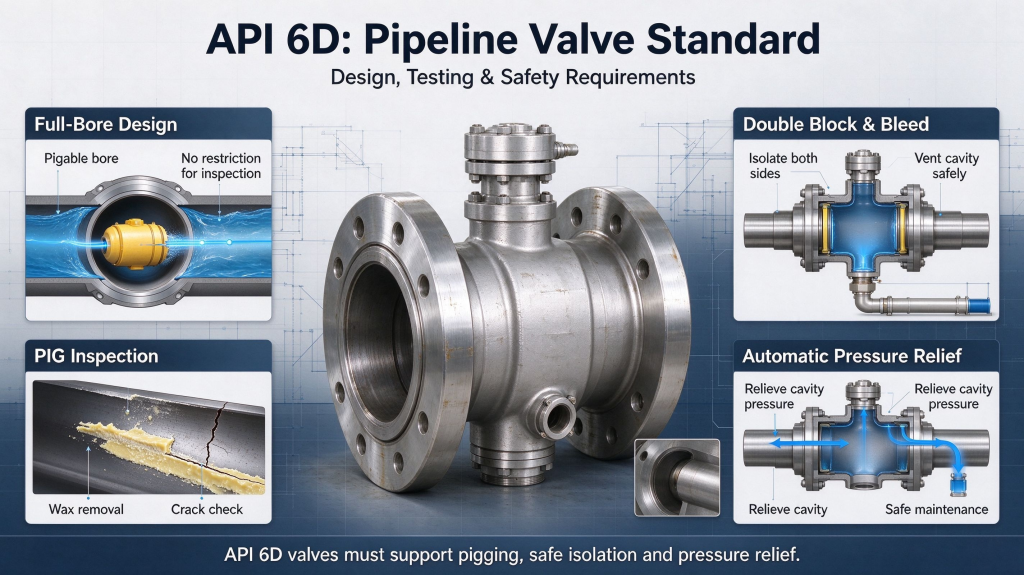
API 6D Pipeline Valve Standard
API 608: Metal Ball Valve Standard
Scope and Applications
API 608 is a common standard in factory pipelines. In refineries and chemical plants, such valves are often used to isolate equipment, public engineering pipelines, and general process piping, that is, process pipelines.
So why are these valves not manufactured according to the specifications of API 6D? The main reason is that it is unnecessary. Inside the factory, if the valve leaks, there are operators on site to inspect, and there are gas detectors and secondary blockade. The whole environment is controlled, so it is done according to API 608. It can save part of the cost.
Design and Testing Requirements
Compared with API 6D, the requirements of API 608 are much more flexible; first of all, it allows the reduced-bore (i.e. standard port) design, which means that the hole diameter on the sphere is smaller than that of the pipe; although this saves money , but the circulation capacity will be lost, and the pressure drop will also rise, but as long as the pump in the factory can withstand it, it is not a big problem.
Here, double block and bleed are not mandatory, and fire testing (i.e. API 607) is also optional, unless specifically specified by the purchaser in the purchase order.
The test follows the ASME B16.34 standard, and the high-pressure hydrostatic shell and seat tests still need to be done, but the mandatory low-pressure gas test mentioned above can be skipped; of course, this is not It is said that the API 608 valve is a sub-product, which only shows that its test requirements are graded in combination with the actual risks of the factory environment.
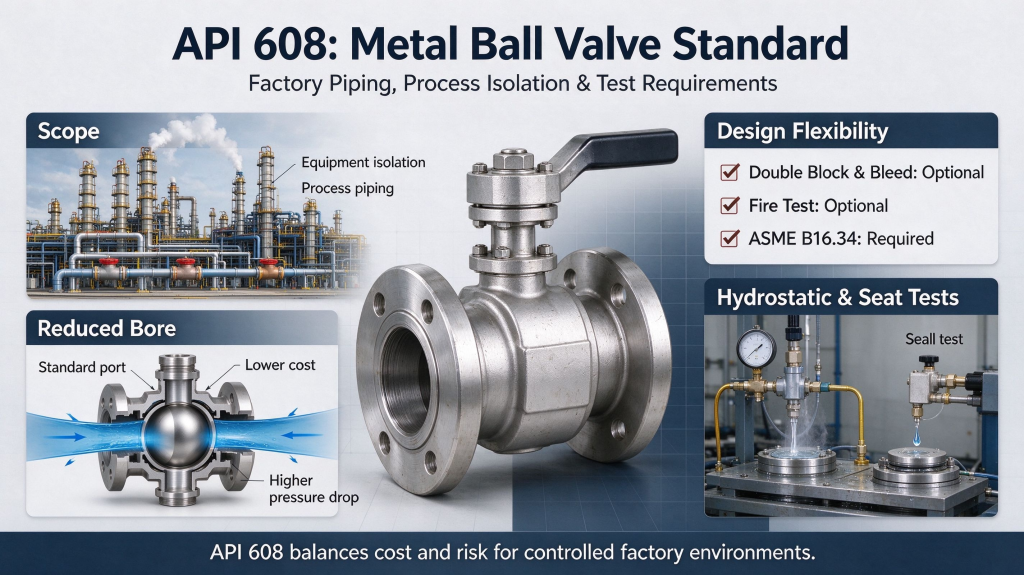
API 608 Metal Ball Valve Standard
Key Differences Between API 6D and API 608
If the two specifications are looked at side by side, it is easier to figure out the reason for the price gap.
Pipeline vs Process Service
The design of API 6D is mainly for the outdoor environment, which is characterised by long distance, high risk, and no personnel supervision; API 608 is designed for factory workshops, which is a controlled space with relatively low risk and budget sensitivity.
Design and Testing Focus
The following quick check form can be prepared for reference before attending the next procurement meeting:
| Feature | API 6D (Pipeline) | API 608 (Process) |
| Bore Design | Full bore mandatory | Full or reduced bore |
| Double Block & Bleed | Required (trunnion) | Not required |
| Fire Testing (API 607) | Mandatory | Optional |
| Low-Pressure Seat Test | Mandatory (gas) | Not required |
| Typical Size Range | 2” to 60”+ | 1/2” to 24” |
Documentation and Certification
When purchasing API 6D products, part of the money is actually spent on documents; the buyer will receive Material Test Reports (MTRs), NDE reports, and third-party inspe for each pressurised component. Ction (TPI) certificate. There are indeed a lot of documents in this set, but this is the requirement of pipeline audits.
As for API 608, it is mainly obtained according to the standard documents issued by the manufacturer’s quality system; it also reflects that in a controlled factory environment, once a failure occurs, the consequences are relatively not so serious.
Which Standard Should You Choose?
If you want to choose the right standard, there are two questions that you can ask yourself first; where exactly should the valve be used, and what will be the consequences in case of leakage?
If the purpose of the valve involves pipeline isolation, acidic working conditions or high-pressure environment, that is, Class 300 or above, or fire protection certification is required by regulations; in this case, API 6D should be selected. This option has high security and traceability, which can avoid unqualified situations in environmental audit and prevent the occurrence of disaster accidents.
However, if the valve is only used in ordinary oil refinery or industrial pipelines inside the factory, the operating pressure is medium and low pressure, that is, Class 150/300, and you are more concerned about the budget cost; then it is more appropriate to choose API 608. It can avoid over-design, thus saving a lot of expenses. There is no need to install a 10,000-dollar pipeline valve into the factory’s water supply line; this practice will only cause a waste of money.
What Makes FLOWORK a Trusted Ball Valve Manufacturer?
If you want to choose the right standard, in fact, only half of it is successful; the other half has to choose a supplier who will not send leaky castings.
FLOWORK has been working in the field of fluid control for many years. They are deeply rooted in the industries of oil and gas, petrochemicals and ships, and are the main suppliers of high-quality ball valves. Some trading companies make people unable to figure out where the parts come from. FLOWORK is different from this kind of company. The whole production process is controlled by themselves, so the quality is relatively stable, and the delivery time is not so long as to wait.
These valves are not only external. Their design and testing are carried out in accordance with international standards such as API 6D, API 598, API 607 and API 6FA. If the customer needs a trunnion-mounted ball valve with a size between 2″ and 56″ and a pressure level spanning from 150LB to 2500LB, they have the manufacturing strength to deliver it. Full-bore or reduced-bore options, automatic pressure relief, fire-safe design, anti-static devices and blow-out proof stems, which can be used according to specific needs. I’m going to pick.
The testing link is relatively reassuring; each valve must be subjected to a rigourous pressure test before leaving the factory. FLOWORK’s engineering team can provide guidance to buyers who have a headache about how to match the corresponding API standards and materials with their media, temperature and pressure.
FAQs
What is the main difference between API 6D and API 608?
API 6D is mainly used for heavy pipe valves. This standard requires full bore design, requires DBB function, and fire testing is also mandatory; in contrast, API 608 is suitable for process The ball valve inside the facility allows the reduced bore design, the DBB function is optional, and fire testing is also optional.
Can a ball valve meet both API 6D and API 608?
It usually doesn’t work, because the design and testing requirements of the two standards are quite different; if the valve is strictly manufactured according to API 6D, it will be much heavier than the standard API 608 process valve, and the price will be much more expensive, so these two standards cannot be mixed together.
Which standard requires fire testing?
API 6D is mandatory for fire testing according to API 607; while API 608 sets fire testing as an option, unless it is specifically written in the purchase order; if the flow processed in the factory The body is a flammable medium, so the requirements for this test should always be clearly put forward when purchasing.
Is API 6D stricter than API 608?
Yes, the tests required by API 6D will be more rigourous, including seat tests of low-pressure gases, and the traceability of the material will be more comprehensive, because once the pipeline fails, it will cause huge environmental damage and safety damage.
Conclusion
To choose API 6D or API 608, in fact, the key is not to distinguish which standard is “better”, but to make the valve compatible with the specific application scenario. In the face of high-voltage pipeline isolation, API 6D can provide corresponding strict safety requirements, test processes and documents; while for the process pipelines inside the facility, API 608 can provide relatively practical and cost-controlled solutions.
If the buyer is preparing to purchase ball valves for the next project, FLOWORK can provide both, whether it is API 6D pipeline valves or API 608 process valves, with strict test standards and global project experience as support. If necessary, you can directly contact FLOWORK to communicate the project situation and confirm the standards and materials required for specific applications.

