 Skip to content
I. Background and Objectives
In high-risk industries such as petroleum, petrochemicals, and coal chemical processing, leaks at valve packing seals are one of the primary sources of fugitive emissions. These leaks not only result in waste of process media and equipment wear but can also lead to safety incidents such as fires, explosions, and poisoning. Additionally, they cause VOC (volatile organic compound) levels to exceed regulatory limits, violating environmental protection regulations. This solution targets mainstream industrial valves such as gate valves, globe valves, ball valves, butterfly valves, and plug valves. By selecting compliant packing, adhering to authoritative testing standards, and implementing end-to-end process control, it ensures low-leakage operation at packing seal points. This helps enterprises meet environmental requirements, reduce operational and maintenance costs, and enhance workplace safety, while providing procurement departments with clear and reliable technical guidance for valve selection.
II. Core Technology Selection: Compliance Requirements for Low-Leakage Packing
Packing is the core component of valve sealing, and its performance directly determines the effectiveness of leak control. This solution requires that all valve packing meet the following standards:
1.API 622 Mandatory Certification:
All packing must pass the API 622 “Type Testing of Process Valve Packing to Prevent Fugitive Emissions” certification. This standard requires the packing to undergo 1,500 mechanical cycles and 3 thermal cycles, using 97% pure methane as the test medium. The temperature range covers ambient to 260°C, with pressures up to 600 psi, ensuring the packing’s sealing stability under frequent opening/closing cycles and temperature fluctuations.
2.Material Selection for Multiple Applications:
High-Temperature Conditions (200°C–400°C): Flexible graphite packing is selected, with an operating temperature range of -29°C to 538°C. It offers excellent thermal stability and resistance to media corrosion, making it suitable for gate valves and globe valves handling steam, high-temperature oil and gas, and similar media.
Medium-to-Low Temperature Highly Corrosive Conditions: Modified PTFE packing is selected, which maintains a low coefficient of friction in environments ranging from -200°C to 200°C. It exhibits excellent resistance to highly corrosive media such as acids, alkalis, and organic solvents, making it suitable for quick-opening and closing valves such as ball valves and butterfly valves.
Custom Solutions for Special Conditions: For plug valves handling media containing solid particles or high-viscosity substances, a composite packing woven from graphite and wear-resistant fibers is used to balance sealing performance with wear resistance.

III. Valve Selection and Testing Standards System
To ensure overall valve sealing performance, procurement requirements must explicitly stipulate that valves pass the following authoritative type test certifications, with standards precisely matched to different valve types:
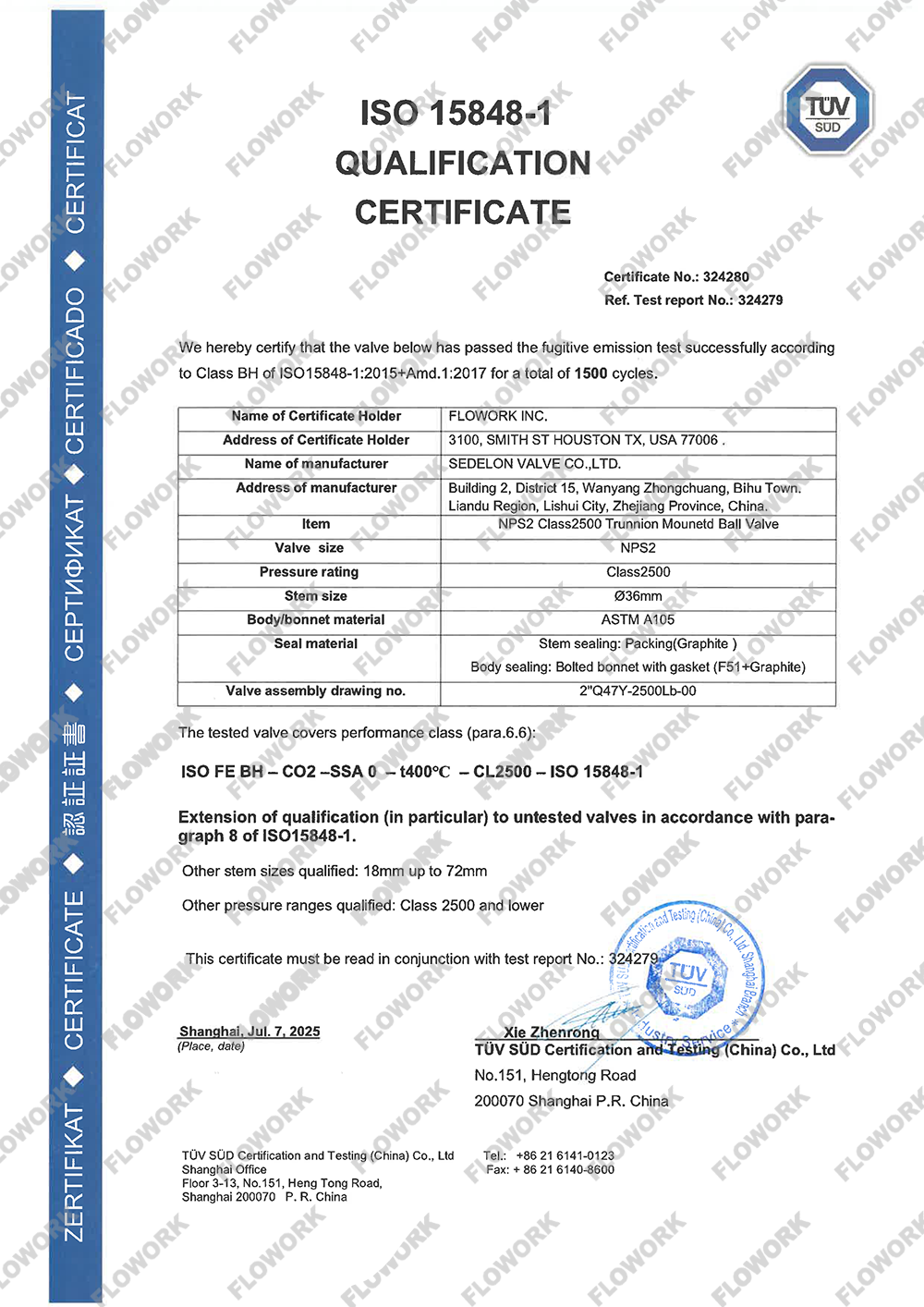
(1) General Basic Standard: ISO 15848-1
All valves must be certified under ISO 15848-1, “Procedures for the measurement, testing, and qualification of fugitive emissions from industrial valves—Part 1: Classification and qualification procedures for valve type testing.” This standard serves as the core international standard for low-leakage valves and provides a graded certification system:
1.Leakage Levels: Divided into three levels: LA (1.0E-05 mg/(s·m)), LB (1.0E-04 mg/(s·m)), and LC (1.0E-02 mg/(s·m)). This plan requires a minimum of Level LB; valves at critical process nodes must meet Level LA.
2.Temperature Range: Certification must cover the actual operating temperature range. For high-temperature conditions, the range must include ambient temperature to 400°C; for low-temperature conditions, the range must include -50°C to ambient temperature.
3.Cycle Life: Select the corresponding durability class based on valve type. Lift-type valves such as gate valves and globe valves must meet Class C02 (1,500 cycles), while rotary valves such as ball valves and butterfly valves must meet Class CC2 (60,000 cycles).
4.Testing Medium: Helium testing is preferred, leveraging the small size and high sensitivity of helium molecules to accurately detect micro-leaks; for systems using hydrocarbon media such as natural gas, methane testing may be used to simulate actual operating conditions.
(2) Specific Enhanced Standards: API 624/API 641
To further enhance sealing reliability, supplementary API standard certifications are required for different valve types:
1.Stem-type valves (gate valves, globe valves): Must pass API 624 “Leakage Testing for Stem-type Valves with Graphite Packing” certification. This standard requires valves to complete 310 mechanical cycles and 3 thermal cycles, with test temperatures ranging from -29°C to 260°C. The leakage rate must be ≤100 ppmv to ensure sealing stability during long-term reciprocating motion of the stem.
2.Rotary Valves (Ball Valves, Butterfly Valves, Plug Valves): Must pass API 641 “Leakage Type Testing for Quarter-Turn Valves” certification. This standard addresses the sealing structure characteristics of rotary valves by strengthening dynamic cycle testing requirements, ensuring that the valve’s leakage control capability under frequent opening/closing and pressure fluctuation conditions meets ISO 15848-1 Class BH or higher.
IV. Comprehensive Quality Control Measures
1.Supplier Qualification Review: Prior to procurement, valve suppliers must undergo a rigorous qualification review. They are required to provide API 622 certification for packing, as well as ISO 15848-1 and corresponding API-specific standard certification reports for valves. Additionally, the supplier’s production process control documents and quality traceability system must be verified.
2.Incoming Inspection and Testing: Upon arrival, valves must undergo sampling acceptance testing:
Static Leakage Testing: A helium mass spectrometer is used to perform static pressure testing on the stuffing box; the leakage rate must meet the requirements of the corresponding grade in ISO 15848-1.
Dynamic Cycling Test: Key valves undergo 100 opening and closing cycles; the leakage rate is retested after the cycle to ensure that sealing performance does not degrade.
3.Installation and Operation/Maintenance Standards:
Installation Phase: Strictly follow packing installation specifications. Packing must be installed and compressed layer by layer, with joints at a 30° or 45° angle. The gland must be tightened symmetrically and evenly, leaving a preload gap of at least 5 mm.
Operation and Maintenance: Establish a regular valve inspection system and test the packing chamber seal performance quarterly. If minor leakage is detected, address it by symmetrically fine-tuning the gland bolts to avoid excessive tightening that could cause stem wear. For valves with excessive leakage or aged packing, promptly replace the packing with API 622-certified material.
V. Analysis of Solution Benefits
1.Environmental Compliance Benefits: By controlling the packing leakage rate to ISO 15848-1 Class LB or below, VOC emissions can be reduced by over 90%, meeting national and local environmental regulations and avoiding the risks of fines and production suspensions for non-compliance.
2.Safety and Cost Benefits: Effectively eliminates safety incidents caused by media leakage while reducing media loss. Based on an annual leakage volume of 1 ton and a media unit price of 5,000 RMB/ton, each valve can save 5,000 RMB annually; by reducing the frequency of valve maintenance and replacement, operational and maintenance costs can be reduced by more than 30%.
3.Brand and Market Benefits: Production facilities equipped with low-leakage valves can serve as a flagship achievement in the company’s green manufacturing efforts, enhancing its brand image in the environmental protection sector. This helps expand into high-end markets and facilitates participation in international project bidding.


